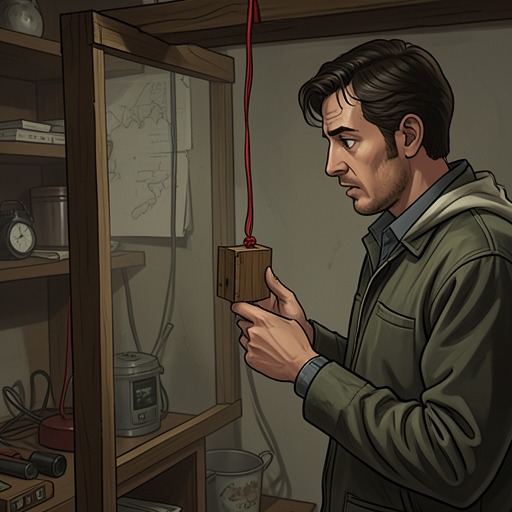
Emma's red wishing string
The ChangelingEmma's red wishing string begins as a keepsake of a ritual Emma encountered in Brazil, but its meaning changes when Apollo Kagwa cuts it from her wrist and promises to fulfill her wishes himself. Kept first as a reminder of that promise and later placed in a family time capsule, the worn thread links Emma's private belief in magic to Apollo's desire to make a future with her—and to the memories he hopes to pass on to their son.
Origin and Rules
While staying with a family in Itapuã, a neighborhood in Salvador, Emma became acquainted with a washerwoman beside Lagoa do Abaete. Her host family warned her away from the woman, whom they called a witch, but Emma liked her. The washerwoman reminded Emma of the mother she had lost: tough, funny, and unconcerned with other people's opinions. Emma began sneaking out to sit with her while she did laundry.
Before Emma left for Manaus, the washerwoman told her to make three wishes for her life and tied the red string around her wrist. Its rule was simple but binding: Emma had to let the string come apart naturally, and her wishes would come true when it fell off. She was not to cut it. Emma initially found the practice amusing and a little mystical, but the thread stayed on her skin for more than six months. It became dirty and ratty, yet she wanted her wishes to come true and admitted that she believed in magic.
The string carries both the washerwoman's instruction and Emma's chosen faith in it. Emma describes turning her hand to watch the red fabric, a small gesture that makes the thread's material condition part of the ritual: it is not pristine or newly symbolic, but worn by time on her body. Its continued presence also leaves the wishes unresolved. Their contents remain private; the object makes the promise of their fulfillment visible without disclosing what Emma asked for.
Apollo Cuts the String
When Emma returns after a year away, Apollo notices the red string and stiffens. He wonders whether it came from a Brazilian man she had loved and whether she had returned with fewer belongings because she meant to leave again. His first response is therefore not to recognize the bracelet as the trace of Emma's experience, but to read it through his anxiety about losing her.
After Emma explains its origin and the rule against cutting it, Apollo takes her hand and pulls it toward him. Repeating inwardly that he is the god Apollo, he picks up a plastic knife and cuts the string in one motion. It falls onto the plastic tabletop; Emma shivers, and he holds on to her hand. The gesture directly violates the ritual as Emma has described it. Rather than waiting for time to fulfill the wishes, Apollo makes an audacious claim on their fulfillment, promising that all three will come true with him.
The cut changes the string from a rule Emma has chosen to obey into evidence of Apollo's intervention. His promise is bold, but the moment does not settle how Emma interprets him: she can see him as arrogant or decide that he is brave and worthy. The scene leaves her response as a choice rather than treating the promise as automatic proof of devotion. The string thus marks a turning point in their relationship while preserving the uncertainty of what Emma will make of Apollo's act.
A Kept Promise
Apollo does not discard the cut thread. He keeps it in his wallet, tucked behind his driver's license, and later explains that he kept it so he would not forget his promise. When Nichelle recalls the string and praises the boldness of his move, she says Emma has already received two of the wishes, though Emma never told Apollo what they were. Her remark connects the private ritual to the couple's life together, but does not identify the wishes or establish that the string's magic caused their fulfillment.
The gap between the washerwoman's rule and Apollo's promise remains important. Emma had been told that the wishes would come true when the string fell off on its own; Apollo instead cut it and pledged to make them come true with him. His keeping the thread gives that interruption a continuing consequence: the object becomes a personal reminder not only of Emma's belief, but of what he said he would do. Its place behind an everyday item in his wallet makes the promise portable and private, carried through ordinary life rather than left behind at the table.
The String in the Time Capsule
Years later, when Apollo prepares to add things to the box he calls Improbabilia, he retrieves the string from his wallet. The thread has bunched up and tightened, so he pulls it straight. It measures only four or five inches and is frayed, but he feels that its fabric seems warm to his touch, as if it still burned with sentimental magic. He places it in the box.
The act changes the string's role once more. Once worn as Emma's charm, it became the remains of Apollo's decisive gesture and a reminder of his promise; now it is an object he deliberately preserves alongside other traces of family history. Apollo is also preparing to read his son a children's book that his own father had once read to him, and he adds objects he intends to explain when the boy is old enough. The string therefore enters a planned act of inheritance: Apollo means to keep both the material remnant and the story attached to it.
Its magic is never confirmed as supernatural fact. What the narrative establishes is the force the string acquires through Emma's belief, Apollo's vow, and his later care in preserving it. A dirty, cut, frayed piece of red thread outlasts the moment when Apollo first tried to turn a promise into certainty. In the time capsule, it holds that promise open for the next generation to hear.